Part 1:
After waking in Arlon, running family
history errands, and cycling until my knees ached, I took the train
from Ciney to Charleroi (70km). As I approached Charleroi, I noticed
more and more graffiti on the regional train exteriors and along the
rail route. I postulate the graffiti is a sign of the worker class
society of southern Belgium.
When alighting the rail station I biked
unconfidently toward Nicholas' Boissart's house. I was immediately
displaced on the road as a function of no bike lanes and numerous
roundabouts which added to the complexity of traversing the urban
landscape. But eventually I arrived at Nicholas' house.
I learned about
Nicholas
Boissart in the Wall Street Journal about three years ago because
he gives urban ruin tours of Charleroi. The City used to be a
bustling industrial City but like other Cities such as Pittsburgh or
Baltimore which had their greatness of industry during the late 1800s
and early 1900s, the industry became obsolete or too expensive to
operate and products dwindled, jobs moved away, but the factories
remained. Nicholas takes people out to see these monstrous ruins and
see the City which once was. All I had to go by was our brief email
exchange and a photo characterizing Nicholas.

I knocked on the door of an old house
from the early 1900s and Immediately upon entering the house is an
artist's house. Poles lay in the hallway, large obscure metallic
pieces hang, and the 2nd largest scarf knitted from
Belgian's citizens are stacked in the corner (The Irish took the Blue
Ribbon). Nicholas is taller than I would have imagined (~6'3”), as
for some reason I imagined him soft spoken. This was not the case.
Nicholas seems Latin from his gestures
and even acts scenes from some of his souvenirs. “Many things in my
house are souvenirs and have stories” as he explains one hilarious
story of how he came across a phallic toy in Antwerp during an artist
show where there were hundreds of them.
As we share a beer from Trappist monks
in Rochefort we exchange our histories. The history I told him was of
my great grandfather, Francois Boudart who has a street named after
him from his industry contributions. I told him I postulated Francois
contributed to the industry in Charleroi. He loves this story and
when being interrupted by a phone call from his friend he first
explains he is with an American who helped ruin Charleroi (he jokes).
After his phone conversation he casually decides the tour starts now.
We head off to City Hall.
City Hall is no ruin but in fact an
opulent building with marble floors and columns and intricate
interior designs. We listen in on an ongoing City Hall meeting and he
tells me the citizens are discussing what to do with old abandon
buildings. This meeting reminds me of many abandon buildings in
Baltimore, where there are some plans to re-purpose some buildings,
but because of the great quantity of empty buildings, the job is
hard.
We exit and the abandon building tour
continues. We walk through a shopping district and Nicholas explains
“The buildings above the shops are empty because they are either
too expensive to renovate or people have moved to the suburbs”.
Again, the similarities between American Cities and Charleroi are at
first alarming, and then as we continue our walk the feeling is
comfortable because there appears to be little difference between
Charleroi and an American City's evolution.
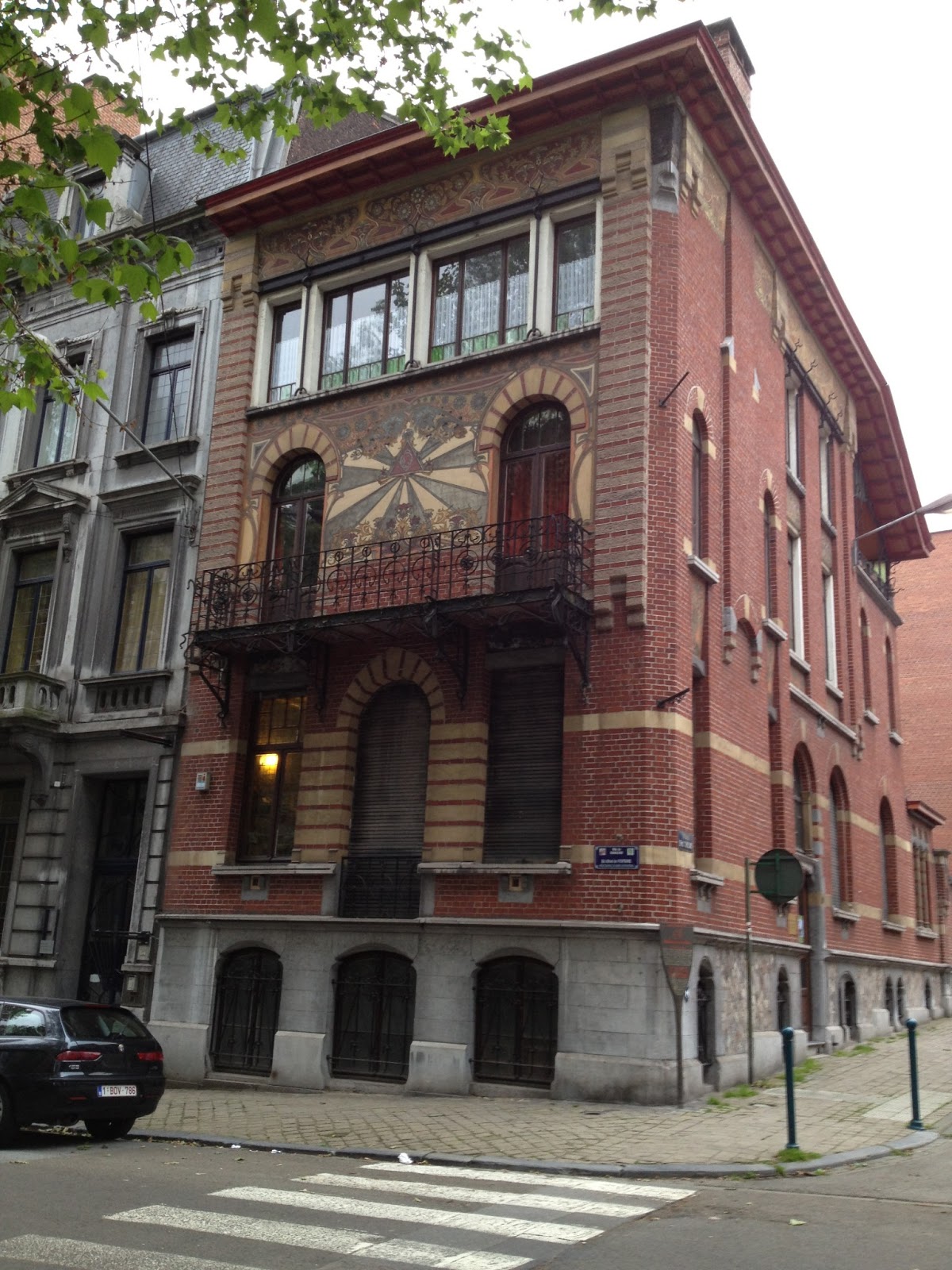
Despite the blight, there are nice
buildings which have well executed etchings in the buildings.
Nicholas loves these buildings because
of their history and care put into constructing them. I like them
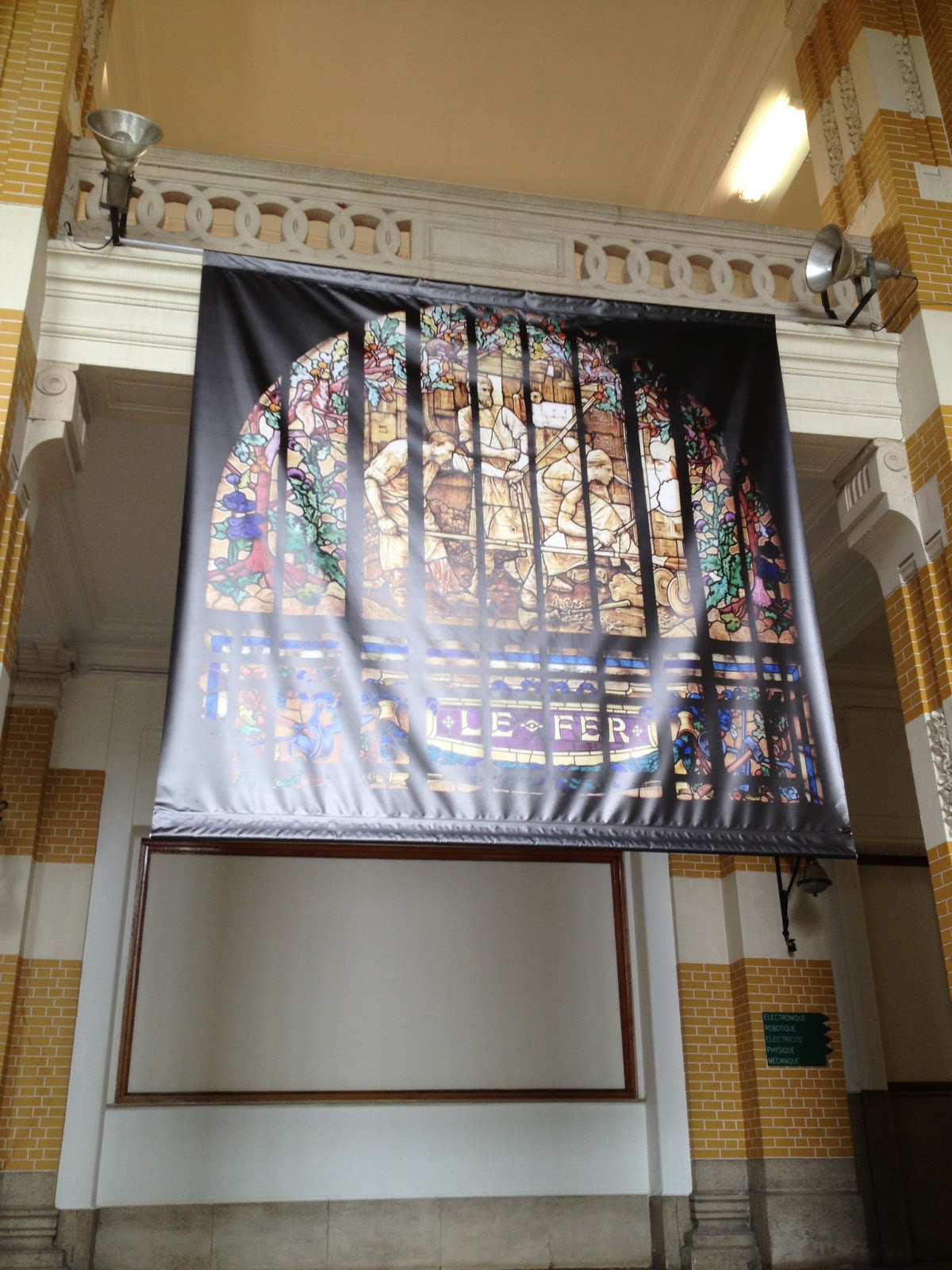
too. We then continue to the Industrial University and the
architecture from these buildings:

I love the font style, which reminds me
of Paris' metro signs.
Later the installations in the roundabouts were a preview of the industrial ruins of Charleroi.
More
on the darker side of Charleroi to come
Part 2:
At the outstretched hand roundabout
there is the Charleroi art museum which set the stage for the ruin
tour to come.
Here are some samples from the museum I
took from the internet.
The exhibition shows mainly dark colors
and a ghastly view of blue collar life in Charleroi. Given I have
taken a ruin tour, consider the activity of Charleroi during its
heyday as you look at the following pictures.
Finally, the tour begins. We are
dropped off at the end of one of the canals. The canals were (and in
some cases still are) the main thoroughfare to transport industrial
goods. In the case of this next photo, we played a little frogger
against the “Claw” to avoid being smashed by recycled metal.
When the claw dropped the various hunks
of metal, the sound was not only thunderous but also quaked the
earth. After this tremor, Nicholas comments “Imagine this place
during all the activity back then, you probably could hear nothing!”
We waiver onward and the industry becomes more dense. The cooling
tour is a first sign.
No, not for nuclear reactors, this was
most likely used for gas power generation of some kind. As we walk
further we become up close and personal with the industry. See this
next large abandon factory.
And the next is a picture of the
factory from the other side with one of the barges plodding through.
And a view from one of the docks
protected from any falling objects above. A strange kind of dock
because of the overhang.
As I'm dumbfounded by the scale of
these abandon relics, Nicholas comments about the Roman Empire as it
relates to Charleroi's industry. He explains the Roman empire was the
greatest empires known to fall. He says one of the main ones was the
economy. Roman entrepreneurs were not able to innovate and create new
products with the Roman's existing economic system and so they moved.
They migrated to present day England, Germany, The Netherlands, or
wherever they could where they thrived. These entrepreneurs took with
them new ideas, energy, and left behind the smoldering ashes of the
economy, when with more and more innovators leaving (and many other
factors of course) the empire ceased to be.
Nicholas' comment was most interesting
because I remember different reasons for the fall of the Roman
Empire. They were: corruption, dictatorships, governance difficulty
and barbarian attacks, but I don't recall the economy being a central
theme of the decline. Also, entrepreneurship (or lack there of) is a
most interesting reason of decline.
Nicholas explains Charleroi used to be
a City of the best glass makers, coal refiners and metal workers. See
these tapestries below, which used to be stain glass windows inside
of the Technical Industrial University Building but were removed for
preservation.
However, when entrepreneurs could not
be, well; entrepreneurs, they sought out places where their ideas
could be fostered, and so the decline of Charleroi endured.
As we exit the canals Nicholas has one
more spot in store for me. We climb a slag heap (which is essentially
spent fuel) to overlook all the factories in the area.
75% of the industrial buildings seen
are abandon. Furthermore, the other grass heaps you see are slag
heaps. The other green spaces are old factories torn down. All around
you see houses. Be sure to zoom in as far as you can when you look at
this image; the quality is good (I think you must download the image). Further imagine the stench or poor
air quality exhibited from these early dirty behemoths; people must
have been coughing.
As we descend the heap de slag,
Nicholas and I are picked up by his faithful companion Benito. He has
one of the coolest cars in town, a classic Peugeot.
So cool in fact, the shifting is done
with what is normally the windshield wiper lever, see next video.
As we cruise around Charleroi we hunt
for the closest dive bar, which is easy as there are many. We enter
one such dive bar that has a really nice pool hall and includes
billiards (the classic one), pool, snooker, and BUMPER POOL!
Wouldn't a Portland bar be more hipster
with one of these? Even though we had no idea how to play, one of the
locals taught us in perfect english; he used to work for NATO and
knew 4 languages. He was also really good at pool.
As we played terribly, I noticed the
lottery games present in the bar. But these were most peculiar
because they were essentially prehistoric lottery games, as opposed
to the modern lottery games in Portland bars. These looked like
pinball machines, but you simply launched the ball and when it
stopped bouncing around potential slots like plinko you either won or
lost.
After we finished our game and beers we
headed over to Benito's studio, which was no ordinary studio. The
studio is an old factory building which has been converted to an art
building. The ceilings are probably 50 feet high and the old interior
cranes sit idle as they probably have been for over 50 years. The
places smells of not only dust but like a retired auto repair shop. I
like the old artifacts of the factory such as the pull cart probably
used to haul huge machines or materials from end to end.
From inside the other room there lies
the new factory, the art factory. This studio is not only for artists
to conceive their next piece but for people to enjoy life. Every
weekend the factory opens for business where drinks are served, music
is performed, and art is appreciated. Rockerill.com is the website of
the studio, if you care to explore.
As us three shoot the shit for the next
hours I think about Charleroi as the past City and present City. The
core of the City was the industry but only a few factories still
operate. Charleroi citizens have discussed what to do with some
buildings, but can all of them be re-purposed? Should they be
re-purposed? People have fled to the suburbs, but how will Charleroi
attract people back to live in the City center, like when the City
flourished. How does a City accept (not forget) the dark, dirty past
and move forward. I pose these questions merely to be thought
provoking.
As I ponder this over beers, art, and
cigarettes the evening turns to night and later turns to morning I
must depart Charleroi to continue my journey northbound. I thank
Nicholas profusely for not only the ruin tour and conversation I've
shared with you, but the cultural experience of Charleroi by meeting
Benito and many other artists in the community. These artists are the
ones who make a good life out of what seems to be nothing. In a way,
they are the new entrepreneurs.